 Add to Chrome
 Add to Firefox
 Add to Edge
Exploring the holographic entropy cone via reinforcement learning
Jan 27, 2026
We develop a reinforcement learning algorithm to study the holographic entropy cone. Given a target entropy vector, our algorithm searches for a graph realization whose min-cut entropies match the target vector. If the target vector does not admit such a graph realization, it must lie outside the cone, in which case the algorithm finds a graph whose corresponding entropy vector most nearly approximates the target and allows us to probe the location of the facets. For the $\sf N=3$ cone, we confirm that our algorithm successfully rediscovers monogamy of mutual information beginning with a target vector outside the holographic entropy cone. We then apply the algorithm to the $\sf N=6$ cone, analyzing the 6 "mystery" extreme rays of the subadditivity cone from arXiv:2412.15364 that satisfy all known holographic entropy inequalities yet lacked graph realizations. We found realizations for 3 of them, proving they are genuine extreme rays of the holographic entropy cone, while providing evidence that the remaining 3 are not realizable, implying unknown holographic inequalities exist for $\sf N=6$.

Multi-Turn Jailbreaks Are Simpler Than They Seem
Aug 11, 2025While defenses against single-turn jailbreak attacks on Large Language Models (LLMs) have improved significantly, multi-turn jailbreaks remain a persistent vulnerability, often achieving success rates exceeding 70% against models optimized for single-turn protection. This work presents an empirical analysis of automated multi-turn jailbreak attacks across state-of-the-art models including GPT-4, Claude, and Gemini variants, using the StrongREJECT benchmark. Our findings challenge the perceived sophistication of multi-turn attacks: when accounting for the attacker's ability to learn from how models refuse harmful requests, multi-turn jailbreaking approaches are approximately equivalent to simply resampling single-turn attacks multiple times. Moreover, attack success is correlated among similar models, making it easier to jailbreak newly released ones. Additionally, for reasoning models, we find surprisingly that higher reasoning effort often leads to higher attack success rates. Our results have important implications for AI safety evaluation and the design of jailbreak-resistant systems. We release the source code at https://github.com/diogo-cruz/multi_turn_simpler
Regularization Strategy for Point Cloud via Rigidly Mixed Sample
Feb 03, 2021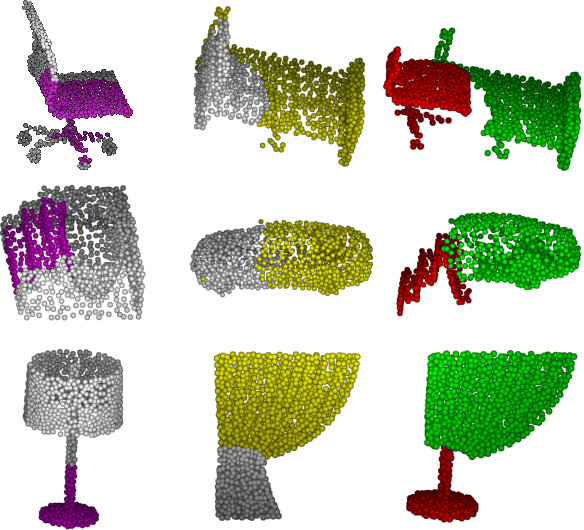
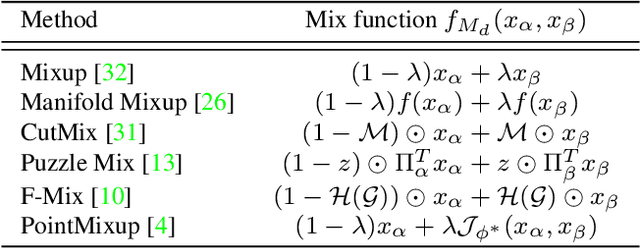
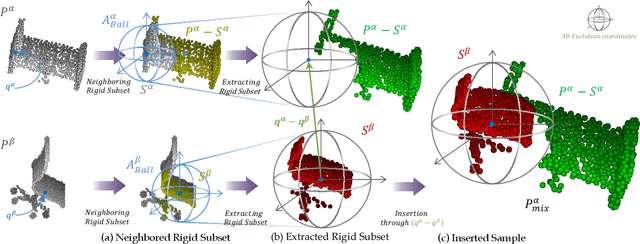
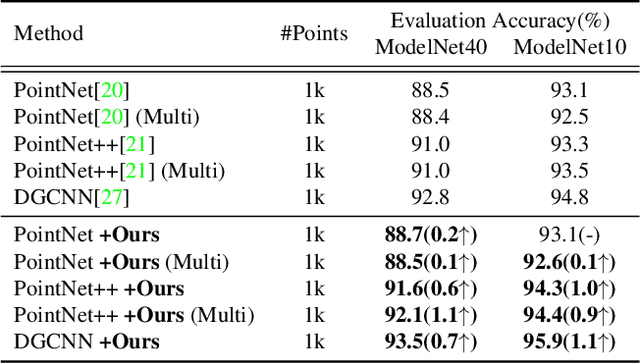
Data augmentation is an effective regularization strategy to alleviate the overfitting, which is an inherent drawback of the deep neural networks. However, data augmentation is rarely considered for point cloud processing despite many studies proposing various augmentation methods for image data. Actually, regularization is essential for point clouds since lack of generality is more likely to occur in point cloud due to small datasets. This paper proposes a Rigid Subset Mix (RSMix), a novel data augmentation method for point clouds that generates a virtual mixed sample by replacing part of the sample with shape-preserved subsets from another sample. RSMix preserves structural information of the point cloud sample by extracting subsets from each sample without deformation using a neighboring function. The neighboring function was carefully designed considering unique properties of point cloud, unordered structure and non-grid. Experiments verified that RSMix successfully regularized the deep neural networks with remarkable improvement for shape classification. We also analyzed various combinations of data augmentations including RSMix with single and multi-view evaluations, based on abundant ablation studies.